AI has made language apps more dynamic, but not every AI product is equally good for serious speaking progress.
AI conversation is a capability, not a complete learning system
Open-ended chat can create endless practice, but endless is not the same as well sequenced. A learner still needs to know what to practice, receive support before a difficult task, and revisit weak language afterward. Without that structure, AI can generate variety while leaving the same bottlenecks untouched.
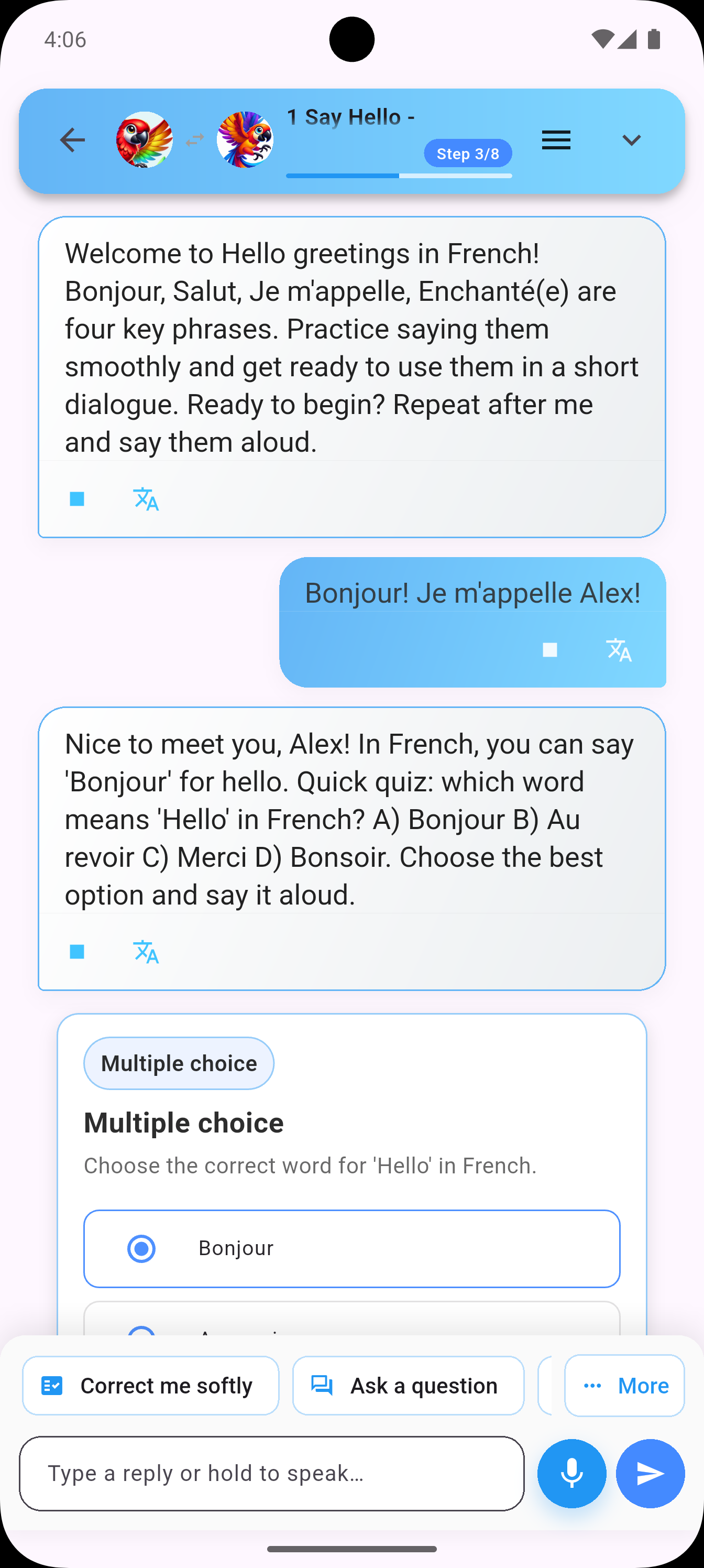
A strong AI speaking app uses conversation inside a loop: prepare, retrieve, interact, receive feedback, and review. The AI should make each part more relevant without making the learner design the entire curriculum from a blank prompt.
- Preparation before open-ended speaking.
- A clear task or scenario during the conversation.
- Feedback, retrieval, and reuse after the conversation.
Useful AI adapts the task, difficulty, and follow-up—not just the topic
Changing a dialogue from restaurants to airports is surface personalization. Deeper adaptation changes how much support you receive, which vocabulary returns, how the other speaker responds, and what the next practice asks you to do.
Give the app a real constraint: you are a hesitant beginner, you need to explain an allergy, and you tend to freeze at follow-up questions. A useful system should prepare the missing language and control the difficulty before increasing variation.
- Name the situation and the result you need.
- State your level and the moment where you usually get stuck.
- Check whether later feedback and review reflect those details.
The best correction is the one you can apply on the next turn
AI can produce more feedback than a learner can use. Volume is not quality. Feedback should identify the change with the greatest effect on clarity, explain it in plain language, and give you a chance to retry while the context is still active.
Communication should come before exhaustive correction. If your message was clear, the system can preserve momentum and coach one improvement. If meaning broke down, it should help you repair the exchange rather than simply mark the response wrong.
- Confirms whether the message was understood.
- Prioritizes one change instead of listing every issue.
- Creates an immediate opportunity to try again.
A good AI app remembers what you need, not just what you said
Each conversation reveals useful learning data: phrases you could not retrieve, corrections you needed, and situations that remained fragile. The app should turn that evidence into later practice. Otherwise every chat starts fresh and progress depends on you remembering what to review.
Look for recall, learned-language tracking, repeated scenarios, and a visible next step. AI is most valuable when it connects sessions into a journey rather than producing isolated moments of impressive conversation.
- Bring weak or useful language back after the session.
- Show which speaking situations are becoming easier.
- Choose a sensible next task from your recent performance.
AI speaking research is promising, useful, and still early
AI language products have moved faster than the evidence base. A 2024 systematic review in Computers and Education: Artificial Intelligence examined 24 empirical studies published from 2017 through 2023 on AI-powered chatbots for English speaking practice. The authors found a growing field but emphasized that research remained limited and that more work was needed to understand effective design.
That finding supports a balanced position. Chatbots can expand access to low-stakes interaction, provide repeatable scenarios, and reduce the scheduling constraints of human practice. It does not follow that any chat interface reliably produces fluency, that results transfer equally across languages, or that longer conversations automatically mean better learning.
When an evidence base is early, product structure matters more, not less. The learner needs a clear task, calibrated support, transparent feedback, and a way for useful language to return. These are testable design properties even when no app can honestly guarantee an outcome for every user.
Be cautious with before-and-after numbers lacking a comparison group, validated measure, sample description, or retention test. A product testimonial may describe a real experience without establishing a general effect. Good marketing should make concrete product claims and leave research claims attached to research.
- A defined sample, comparison condition, validated outcome, and follow-up period.
- A distinction between confidence, engagement, and proficiency.
- A direct link to the underlying research.
The chatbot should sit inside a prepare–perform–repair–retain loop
Open chat gives the learner freedom and a blank page. Beginners may not know what to ask, intermediates may recycle comfortable language, and both can end a conversation without knowing what mattered. A learning system should reduce curriculum decisions while preserving meaningful choice.
Preparation supplies the language and context needed for the task. Performance requires the learner to create responses. Repair confirms meaning and prioritizes one improvement. Retention brings important language back after the session. AI can personalize each stage, but omitting a stage leaves the learner to build it manually.
Output research helps explain the value of performance before exhaustive explanation. Trying to express meaning can reveal a gap and focus attention on the relevant form when feedback arrives. The system should therefore allow an honest attempt, not prefill every response in the name of support.
Run one scenario and trace the loop. Did the app prepare the difficult part? Did your answer affect the next turn? Did feedback produce a retry? Did the phrase return later? If the experience ends after an entertaining chat, it may be a conversation product without being a complete learning product.
- Prepare it, retrieve it, repair it, and retrieve it again later.
- Check that adaptation uses performance, not only selected interests.
- Prefer a visible next step over unlimited blank chat.
Fluent-sounding feedback can still be wrong, excessive, or poorly timed
Generative systems are designed to produce plausible language. They can misunderstand speech, overcorrect acceptable variation, miss cultural nuance, or explain a rule confidently without reliable grounding. Speech recognition also reflects microphone quality, background noise, accent coverage, and model limitations. Feedback should be treated as a useful signal with boundaries.
A responsible app identifies what it is evaluating and avoids presenting an AI score as an official proficiency result. It should let learners hear or inspect a model, ask for explanation, and focus on communication before minor polish. When confidence is low, the system should say so or offer alternatives rather than invent certainty.
Timing matters. Feedback during every word can fracture the message. A practical sequence is complete the turn, confirm meaning, identify one high-value change, and retry. Research on oral corrective feedback supports the role of feedback while also showing that type and instructional conditions matter; more interruption is not automatically more learning.
Users should also control sensitive data. Voice practice may involve personal stories, work details, or location information. Clear privacy terms, sensible defaults, and the ability to delete recordings are part of product quality, not separate legal decoration.
- State its scope, prioritize meaning, and support verification.
- Create a retry rather than interrupt every phrase.
- Explain voice-data handling and deletion clearly.
Evaluate an AI app for seven days with evidence from one real scenario
Choose a conversation that matters and record a baseline. Then use the app for a week with that speaking job. Score structure, relevance, independent output, feedback usefulness, delayed recall, and transparency. Do not give extra credit for visual polish unless it helps you return and do the work.
Test personalization with a specific constraint. Tell the system your level, goal, and common failure. See whether it changes the lesson, scaffolding, partner behavior, and next review. Topic substitution alone is shallow personalization; performance-informed progression is more meaningful.
On day seven, rerun the baseline with one unexpected turn. Note response speed, sustained range, clarity, and repair. The result is not a clinical trial or official proficiency assessment. It is a disciplined product trial anchored to the job you need done.
Finally, inspect the subscription and claims. Verify current language coverage, platform features, price, renewal, and cancellation directly. Prefer claims such as offers guided roleplay over claims such as guarantees fluency. The best AI language app is the one whose actual loop helps you practice the right behavior and whose limits are clear enough to trust.
- Structure, relevant adaptation, real output, feedback, retention, and trust.
- Use one baseline and final scenario with a controlled variation.
- Verify changing features and terms before purchasing.
AI can multiply rehearsal without replacing cultural and interpersonal calibration
AI excels at availability and repeatability. It can generate another hotel exchange at midnight, tolerate ten retries, and vary a prompt quickly. Human interaction adds independent intention, social consequence, relationship, cultural judgment, and the experience of being understood by a real person.
Use AI to prepare and increase volume. Use people to calibrate what sounds natural, respectful, and effective in the communities where you will speak. A teacher can diagnose a persistent pattern; a partner can reveal timing and pragmatics; real interaction shows whether repair works beyond the model.
The strongest workflow alternates them. Rehearse privately, test narrowly with a person, capture surprises, and return to AI for targeted repetition. This makes human time more focused without pretending simulated conversation is identical.
An app should encourage transfer rather than imply that more bot time is the final goal. Useful milestones point outward: handle the appointment, join the meeting, or sustain the family conversation.
- Use AI for volume and controlled variation.
- Use people for culture, timing, and genuine understanding.
- Bring human surprises back into focused rehearsal.
Language coverage and apparent confidence are not the same as reliable expertise
An AI may produce text in many languages while having uneven speech recognition, pronunciation models, dialect coverage, cultural knowledge, or instructional quality. Verify the language and mode you will actually use. A text demo does not prove strong voice interaction.
Test accents, background noise, repair, and a culturally specific scenario. Ask the app to explain uncertainty and provide alternatives. Compare important corrections with a trusted dictionary, teacher, or authoritative resource. Fluent prose should not discourage verification.
Look for product-level safeguards: scoped feedback, clear confidence language, reporting, correction history, and user control. The model's general capability matters, but the surrounding interface determines whether uncertainty becomes visible and useful.
Choose the app whose limits fit the risk. Casual low-stakes rehearsal tolerates more uncertainty than professional, medical, or legal communication. High-stakes language deserves human review and authoritative terminology.
- Test the exact language, dialect, and voice mode.
- Verify important corrections independently.
- Escalate high-stakes language to qualified humans.
Ask twelve questions before an annual AI subscription
Check four learning questions: Does it prepare, require output, prioritize feedback, and schedule return? Check four AI questions: Does it state uncertainty, support your exact language and voice mode, allow verification, and adapt from performance? Check four trust questions: Are price, renewal, voice-data use, and deletion clear?
Run the questions inside one scenario rather than accepting marketing answers. Trigger a misunderstanding, make a deliberate retrieval error, return the next day, and inspect whether the system remembers the learning need. Test the microphone in your normal environment.
No product will be perfect across all twelve. Decide which failures are tolerable for low-stakes rehearsal and which violate the job or your trust. A useful trial produces evidence; a dazzling demo produces only possibility.
- Four learning, four AI, and four trust questions.
- Test behavior inside a real scenario.
- Separate tolerable limitations from deal breakers.
Sources and further reading
The research below informs the learning principles in this guide. Individual results depend on the learner, language, task, and practice conditions.
- Labadze, Grigolia & Machaidze (2024), AI Chatbots for EFL Speaking PracticeA systematic review of 24 empirical studies published from 2017 through 2023; the authors describe the evidence base as promising but still early.
- Lyster & Saito (2010), Oral Feedback in Classroom SLA: A Meta-AnalysisA meta-analysis of oral corrective-feedback research in second-language instruction.
- Izumi et al. (1999), Testing the Output HypothesisA second-language study examining when producing language promotes noticing and later performance.
- ACTFL Proficiency Guidelines 2024 — SpeakingACTFL describes functional speaking through functions and tasks, accuracy, context and content, and text type (FACT).