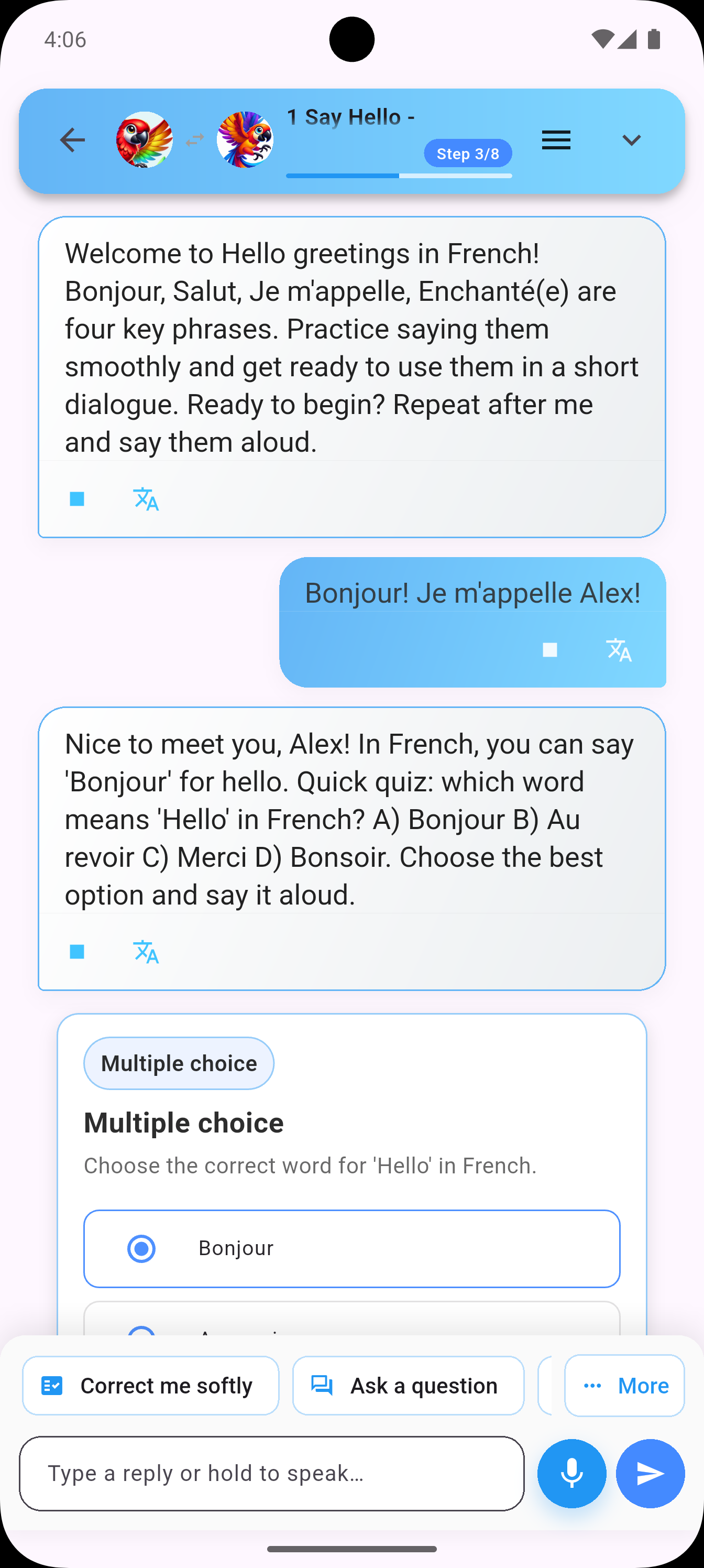
This is one of the most common frustrations in language learning: you know the material when you see it, but it disappears when you need to say it.
Familiarity and availability are not the same skill
A word can feel completely known when you read it and still remain unavailable when you speak. Reading supplies spelling, context, and time. Conversation asks you to start from an idea, find the language, shape it into a response, and do all of that quickly enough to keep the interaction moving.
Treating this gap as a memory failure often leads to more exposure: more flashcards, videos, and rereading. Exposure can strengthen recognition, but active speaking also needs practice that begins with meaning and forces you to retrieve the words yourself.
- Hide the word and explain the idea aloud.
- Use it in a response to a realistic question.
- Return the next day and try again before reviewing.
Attach words to situations, intentions, and neighboring phrases
Isolated translations give your memory a thin route to the word. Conversation provides different cues: who you are speaking to, what you want, what was just said, and which phrases usually sit nearby. Practicing inside a scenario builds more useful paths back to the language.
Instead of learning a single word for reservation, practice the cluster around it: I have a reservation, it is under this name, it is for two people, and can we change the time? The cluster becomes a reusable speaking unit rather than a disconnected definition.
- Add one phrase that starts the interaction.
- Add one phrase that gives a detail.
- Add one phrase that repairs a likely problem.
Short, repeated attempts work better than one polished performance
If you wait until a response is perfect before saying it, you train planning more than conversational access. Use short attempts with a time boundary. Give yourself a few seconds to begin, finish with the language you have, then inspect the gap afterward.
Repeat the same prompt three times. The first attempt diagnoses the problem. The second integrates one correction. The third aims for a smoother start. Keeping the prompt stable lets you feel whether retrieval is improving instead of confusing difficulty with a constantly changing topic.
- Begin within five seconds, even with a simple answer.
- Correct one missing phrase—not every imperfection.
- Repeat until the opening comes without a long pause.
Let your speaking failures choose what returns tomorrow
Generic review treats every saved word as equally important. Speaking practice gives you better information. The phrase you needed but could not reach, the connector that slowed the sentence, and the repair you failed to make are high-value review items because they came from real use.
After each session, save no more than three gaps. Try them cold the next day, place them back into the original exchange, and then use one in a slightly different scenario. This turns review into preparation for future speaking rather than maintenance of a vocabulary collection.
- Retrieve yesterday's three weak phrases before looking.
- Reuse them in the conversation where they first failed.
- Transfer one phrase into a new but related situation.
Comprehension supplies cues that conversation removes
When you read a sentence, the spelling is present, neighboring words narrow the meaning, and you can pause. When you listen, the speaker supplies pronunciation, grammar, and context. In conversation, you begin with an intention. You must select language, assemble it, pronounce it, monitor the listener, and continue under time pressure. Familiarity during input is therefore not evidence that every production step is ready.
This is why a translation can feel obvious one second after someone else says it. The knowledge exists, but the route from intention to form is slow or weak. More exposure may strengthen the representation while leaving that route untested. The learner needs tasks that begin with meaning and delay the answer.
Karpicke and Roediger's retrieval research demonstrates a general memory principle relevant here: retrieving learned material can do more for long-term retention than repeatedly studying it. Language production is more complex than a word-list test, so the experiment should not be overextended. Still, a routine that never asks for retrieval is poorly matched to a problem defined by retrieval failure.
The first intervention is diagnostic output. Describe yesterday without notes. Answer a likely travel question. Explain a simple problem. Capture the places where meaning outruns language. Those gaps are a personalized curriculum created by use rather than guesswork.
- The word is unknown, known but slow, available only in one phrase, or blocked by pressure.
- Each failure needs a different response.
- Do not prescribe more vocabulary until you know which one occurred.
Learn words as response-ready clusters rather than isolated translations
A dictionary pair is efficient for recognition but thin for speaking. Productive knowledge includes pronunciation, common grammar, useful neighbors, register, and the situations that cue the word. You do not need to master every dimension before speaking. You do need enough of a cluster to place the item inside a message.
Take the word available. A flashcard may pair it with a translation. A speaking cluster adds Is this available?, Do you have anything available later?, and The earlier time is not available. Now the learner practices question form, time language, negation, and a common service interaction around one item.
Clusters should remain small. Collecting twenty example sentences reproduces the original volume problem. Choose an opening, a core message, and a repair or follow-up. Retrieve the phrases from situation cues and recombine them. The goal is not a fixed script but a compact set of parts that can survive variation.
Context also improves review quality. Instead of asking what does this word mean?, ask what would you say when the receptionist offers the wrong time? The cue resembles the future use, and the answer must arrive as language rather than recognition.
- One line that opens or frames the situation.
- One line that expresses the key meaning.
- One line that clarifies, changes, or repairs the message.
Use spacing to find what is becoming durable—and what is only warm
Immediate repetition measures what remains active in short-term attention. It can improve smoothness, but it does not show whether the phrase will be available tomorrow. A delayed attempt is more uncomfortable precisely because the learner must reconstruct the response. That effort produces better evidence about durability.
Cepeda and colleagues' distributed-practice synthesis covered 839 assessments from 317 experiments. Their results emphasize that spacing interacts with how long the learner wants to remember. A speaking routine should use more than one scale: a quick retry for correction, a next-day retrieval for access, and later returns for durability and transfer.
Use expanding complexity rather than an obsessively calculated schedule. Retry immediately after feedback. Return the next day before reviewing. Revisit later in the week inside a varied scenario. Bring the phrase back after a longer gap if it remains important. If retrieval fails, shorten the gap or restore a cue; do not simply mark the item wrong.
The useful metric is not the number of reviews. It is the amount of support required. A phrase moves toward active use as the learner can produce it after longer gaps, from more varied cues, and inside a live sequence rather than only in isolation.
- Immediate retry for incorporating feedback.
- Next-day retrieval for checking access.
- Later scenario reuse for durability and transfer.
Reduce anxiety without removing the need to respond
Pressure can expose retrieval weakness, but overwhelming pressure can make practice uninformative. If the learner freezes completely, the task may be testing distress more than language. The solution is not to remove response demands. It is to control them: predictable setting, limited language target, supportive time window, and permission to simplify.
Begin with low-stakes private output. Use recorded prompts or guided roleplay. Let the learner request repetition and keep a small rescue bank containing phrases such as Let me say that another way. Once the exchange is manageable, reduce preparation time, vary the other speaker, and add a complication.
Feedback should preserve communication. First confirm what was understood. Then identify one upgrade and rerun the moment. A learner who receives ten corrections may remember the feeling of failure more clearly than any corrected form. Focused feedback turns the failed retrieval into a specific next attempt.
Transfer to real people gradually. Use the practiced line in a predictable human interaction, then reflect immediately afterward. What came on time? What was understood? What did you need but lose? The real conversation becomes another diagnostic input to the practice loop rather than a final exam on your identity as a speaker.
- Private predictable response, varied roleplay, then a narrow real interaction.
- Keep repair phrases available before removing other support.
- Judge whether the message moved, not whether every form was perfect.
A word is not fully speaking-ready if only its written form is accessible
Learners sometimes retrieve a word on paper and still hesitate aloud because its sound shape, stress, or surrounding rhythm is uncertain. Productive practice should connect meaning, sound, and placement. This is not a demand for accent elimination; intelligible access is the goal.
Build from a model. Listen, notice the stressed portion and neighboring sounds, then produce the phrase from meaning rather than immediately echoing it. Delayed imitation is more revealing than simultaneous shadowing because it removes the audio support for a moment.
Place the item inside two sentence frames and one conversational response. Record only if comparison helps. Speech recognition can offer a signal but may reflect accent coverage, noise, and microphone quality, so verify with a model or knowledgeable listener when accuracy matters.
If the word remains slow, simplify the sentence and preserve the communicative job. Automaticity grows through successful coordinated attempts, not through forcing maximum complexity around every new item.
- Connect meaning, sound, and a sentence frame.
- Use delayed rather than only immediate imitation.
- Prioritize intelligibility over accent mimicry.
Move active vocabulary across cues without making practice random
A phrase can become fast in one memorized exchange while remaining unavailable elsewhere. Transfer requires new cues. Once the original scenario is stable, change the speaker, location, tense, or intention one at a time. The core language remains while the route back to it broadens.
Use near transfer before far transfer. Move reservation from a hotel to a restaurant before expecting it in an abstract business discussion. Reuse a repair phrase across several situations because its function remains constant even when content changes.
Interleave a small number of mature scenarios. Randomly mixing ten fragile topics increases noise. Alternating two or three established situations forces cue selection while preserving enough repetition for improvement.
Measure whether the item appears without deliberate insertion. First, require it in a prompt. Later, create a situation where it is useful but not named. When the learner selects it independently, vocabulary is moving from practiced answer toward flexible resource.
- Vary one cue at a time.
- Move from near to farther contexts.
- Test independent selection, not only required use.
Move a small vocabulary set from recognition to flexible use
Choose twenty high-value words and phrases from one domain—not two hundred unrelated items. In week one, build sound and response clusters. Week two emphasizes cold retrieval and short answers. Week three places the language into multi-turn scenarios. Week four varies context and tests delayed access.
Remove items from intensive practice when they appear reliably across more than one cue and after a delay. Keep fragile items in a smaller queue. Add new vocabulary only as space opens or a real conversation exposes a higher-priority gap.
Finish with two recordings: the original scenario and a related transfer scenario. The useful result is not that every item appeared. It is that the learner selected enough language independently to complete the communicative job.
- Limit the set and deepen its cues.
- Require delayed and contextual retrieval.
- Graduate items by flexible use, not familiarity.
Sources and further reading
The research below informs the learning principles in this guide. Individual results depend on the learner, language, task, and practice conditions.
- Karpicke & Roediger (2008), The Critical Importance of Retrieval for LearningExperimental evidence that repeated retrieval can strengthen long-term retention more than additional study alone.
- Cepeda et al. (2006), Distributed Practice in Verbal Recall TasksA quantitative synthesis covering 839 assessments from 317 experiments reported across 184 articles.
- Izumi et al. (1999), Testing the Output HypothesisA second-language study examining when producing language promotes noticing and later performance.
- Lyster & Saito (2010), Oral Feedback in Classroom SLA: A Meta-AnalysisA meta-analysis of oral corrective-feedback research in second-language instruction.