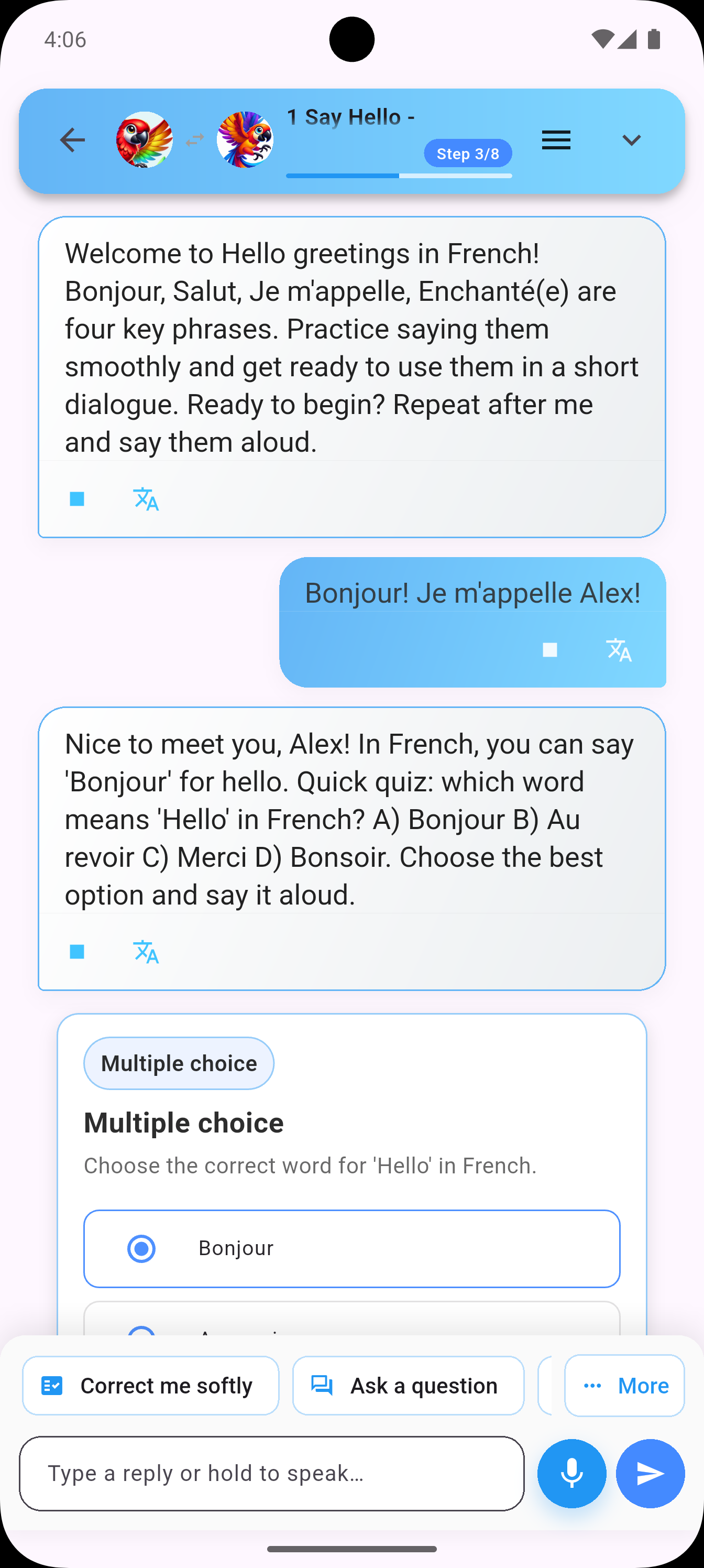
A lot of apps say they help with speaking. Fewer apps are built around the real bottlenecks that stop learners from speaking comfortably in everyday situations.
Count what the app asks you to produce, not what it lets you consume
Most language apps contain audio, vocabulary, and some microphone features. That does not automatically make them speaking apps. The useful question is how often you must create a response from meaning rather than tap, repeat, or rearrange an answer that is already visible.
Test an app for ten minutes and keep a simple tally. How many times did you choose your own words? How many times did another turn depend on your response? How often did you have to retrieve language without a prompt? The pattern matters more than a long feature list.
- Look for responses you create, not sentences you assemble.
- Check whether speaking changes what happens next.
- Notice whether the app supports you before and after a difficult reply.
Good feedback tells you what to change on the next attempt
A score without a next step is weak feedback. Speaking feedback should help you decide whether the problem was meaning, missing language, phrasing, pronunciation, or response speed. It should also distinguish between a mistake that blocks communication and one that can wait.
The best test is immediate usefulness. After reading the feedback, can you try the same response again and make it clearer? If the app produces a wall of corrections, a vague percentage, or praise with no direction, it may be evaluating you without actually coaching you.
- Specific enough to act on in one more attempt.
- Prioritized around communication before polish.
- Connected to a chance to repeat the response immediately.
The learning loop should continue after the conversation ends
A realistic conversation can still become disposable practice if nothing returns later. Useful words, repairs, and corrections should reappear in recall or another scenario. That is how a strong session becomes easier access tomorrow rather than a one-time performance.
Check what the app does with your weak moments. Does it remember the phrase you could not retrieve? Does it bring corrected language into review? Can you revisit the scenario with variation? Retention is not separate from speaking; it is what makes speaking gains available again.
- Missed language returns in later recall.
- Useful phrases are reused in more than one context.
- Progress reflects easier retrieval, not only completed lessons.
Personalization should change the practice, not just the label
Selecting travel or work during onboarding means little if everyone receives the same lesson sequence afterward. Meaningful personalization changes the situations, vocabulary, difficulty, and feedback based on what you want to handle and where you currently get stuck.
Ask the app for a scenario from your actual life. A useful system should help you prepare for that conversation, not merely generate an open-ended chat about the topic. The combination of guidance and relevance is more valuable than novelty alone.
- Practice a specific conversation from your life.
- Adjust difficulty without losing the situation's realism.
- See the next lesson respond to what happened in the previous one.
Use functional ability as the standard, not microphone activity
An app can record your voice constantly without building much conversational ability. Repeating a displayed sentence measures imitation. Reading aloud can support pronunciation. Neither task requires you to decide what meaning to express, retrieve language for it, and respond to another person. A speaking app should include those productive demands rather than using the microphone as proof by itself.
ACTFL's 2024 proficiency guidelines offer a stronger lens. Speaking is described through functions and tasks, accuracy, context and content, and text type. Those four FACT criteria keep evaluation connected to communication. The key question becomes what a learner can accomplish, under which circumstances, with what degree of control—not how many voice exercises were completed.
Turn that framework into a product test. Ask the app to prepare you for one function such as explaining a problem. See whether practice includes the context, likely follow-ups, and language needed to sustain more than one sentence. Then introduce a small change. If the experience collapses as soon as the script changes, it is rehearsing a line rather than developing a speaking capability.
This does not mean every beginner needs open-ended conversation. Guidance can be extensive. The defining feature is that support eventually withdraws and the learner creates meaning. A well-designed app can move from model to scaffolded response to independent response without throwing the user into a blank chat box.
- Does the learner choose language to accomplish a task?
- Does another turn depend on the response?
- Does support decrease as the exchange becomes more familiar?
More correction is not automatically better coaching
Speech produces many possible corrections: grammar, word choice, pronunciation, pacing, register, and cultural fit. Presenting all of them at once can turn a successful message into a wall of failure. Research on oral corrective feedback supports feedback as a meaningful part of second-language instruction, but effects depend on the type of feedback, the target, and the learning conditions. Product design still has to make a pedagogical choice.
For a learner, the most useful first distinction is communicative. Was the message understood? If not, feedback should repair meaning. If it was, the app can preserve momentum and select the change most likely to improve the next attempt. A prioritized correction with immediate retry often has more practical value than a detailed report the learner never uses.
Check whether the app distinguishes pronunciation recognition from pronunciation quality. Speech recognition systems can misunderstand a perfectly acceptable accent or accept speech that is intelligible to the model but unnatural to a person. A responsible interface presents its signal as feedback, not as an infallible verdict. It should let learners hear a model and compare, not merely display a score.
The final test is behavioral: does feedback change what happens next? The weak phrase should return, the learner should retry, or a later scenario should require the improved form. If the correction disappears when the screen closes, it may be informative but it is not part of a learning loop.
- Prioritized around meaning before polish.
- Clear about what the system can and cannot judge.
- Connected to immediate retry and later reuse.
The session after the conversation may matter just as much
Conversation practice creates a stream of high-value evidence. It reveals the phrase that would not come, the connector that slowed the response, and the misunderstanding the learner could not repair. A speaking app should capture those moments and turn them into later retrieval. Otherwise every conversation produces insight that the learning system promptly forgets.
The broader memory literature makes the principle hard to ignore. Cepeda and colleagues examined 839 assessments across 317 experiments in their synthesis of distributed practice. The optimal schedule varies with the desired retention period, but spacing learning episodes is not equivalent to massing them together. A product should not let five immediate repetitions masquerade as durable learning.
Look for a visible path from mistake to review to reuse. The exact word might return tomorrow as a recall prompt, then appear later inside a related scenario. The system should allow effort before revealing the answer. Repeated exposure is helpful, but repeated retrieval better matches the demand of speaking.
Retention design also keeps personalization honest. If the app remembers only your selected topic but not your actual performance, it is customizing content rather than adapting learning. A stronger system changes review and next steps based on what was difficult to produce.
- Does the app notice that retrieval failed?
- Does the phrase return after a meaningful delay?
- Does it reappear inside a conversation rather than only a flashcard?
Evaluate the app with one conversation and a seven-day scorecard
App stores encourage comparisons by feature list, rating, and price. Those signals cannot tell you whether a product fixes your bottleneck. A fair trial starts with one conversation you care about and a baseline recording. Try the situation without notes. Mark the slow start, missing phrases, failed follow-ups, and repair problems.
Use the app on that same speaking job for a week. Do not judge only whether sessions were enjoyable. Record how much of the time required retrieval, how often feedback led to a retry, and whether weak language returned later. A strong product should make the next action obvious without trapping you in one rigid script.
On the seventh day, run the baseline scenario again with one variation. Compare response speed, number of sustained turns, and ability to repair. These are not official proficiency measures, but they are honest observations of transfer. If the app generated many completed activities and no change in the scenario, the learning loop deserves scrutiny.
Finally, inspect trust. Pricing and renewal terms should be clear. Claims should distinguish practice signals from official assessments. AI-generated feedback should not pretend to be perfect. The best speaking app is not the one with the loudest fluency promise; it is the one that helps you do more of the conversation and understand what to practice next.
- Relevant output, actionable feedback, delayed recall, scenario progression, and transparent claims.
- Use the same baseline and final scenario.
- Choose the product that changes off-screen performance, not only in-app completion.
Engagement should keep you near the hard behavior, not help you avoid it
Streaks, reminders, challenges, and celebration can support consistency. The design question is what behavior they reinforce. If the shortest recognition task preserves the same reward as a demanding speaking session, a learner can maintain engagement while repeatedly choosing around the stated goal.
Look for motivation tied to useful milestones: complete a scenario, retrieve yesterday's weak phrases, or handle a follow-up with less support. Rewards need not become austere. They simply should point toward the behavior the product claims to develop.
A good app also offers an achievable floor. On a busy day, the learner should be able to perform a short speaking rep rather than abandon the loop. On a strong day, deeper variation should be available without endless novelty becoming the default.
After a week, compare the activity you intended with the activity the interface made easiest. Product design is a silent curriculum. The prominent button, default task, and celebrated metric tell you what the system truly values.
- Identify the behavior rewards protect.
- Check whether the easiest path still contains output.
- Prefer functional milestones over completion alone.
Privacy, accessibility, and transparent claims belong on the scorecard
Speaking practice may contain voice recordings, location details, work information, and personal stories. Before paying, learn whether audio is stored, how it is used, how long it remains, and whether you can delete it. A polished lesson does not compensate for terms you would not accept if they were written beside the microphone.
Accessibility affects learning quality. Captions, adjustable playback, keyboard support, readable contrast, clear microphone states, and alternatives when speech recognition fails help more learners complete the intended task. Difficulty should come from producing language, not from guessing whether the interface heard you.
Claims also require boundaries. In-app fluency signals can guide practice without becoming official proficiency ratings. AI feedback can be useful without being perfect. Pricing can be competitive without hiding renewal. Trust grows when the product names what a signal means and what it does not mean.
Use a final pre-subscription check: Can I understand the price and cancellation? Can I control voice data? Can I use the core loop with my access needs? Are outcomes described as practice support rather than guarantees? These questions predict whether the product remains usable after novelty fades.
- Read voice-data and deletion terms.
- Test core accessibility states.
- Reject unsupported proficiency guarantees.
Sources and further reading
The research below informs the learning principles in this guide. Individual results depend on the learner, language, task, and practice conditions.
- ACTFL Proficiency Guidelines 2024 — SpeakingACTFL describes functional speaking through functions and tasks, accuracy, context and content, and text type (FACT).
- Lyster & Saito (2010), Oral Feedback in Classroom SLA: A Meta-AnalysisA meta-analysis of oral corrective-feedback research in second-language instruction.
- Karpicke & Roediger (2008), The Critical Importance of Retrieval for LearningExperimental evidence that repeated retrieval can strengthen long-term retention more than additional study alone.
- Labadze, Grigolia & Machaidze (2024), AI Chatbots for EFL Speaking PracticeA systematic review of 24 empirical studies published from 2017 through 2023; the authors describe the evidence base as promising but still early.