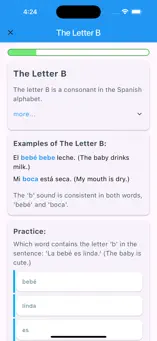
Most learners do not need more random tips. They need a system that helps them remember useful language, retrieve it under pressure, and repeat it in situations that feel real.
Define the conversation before you choose the material
A goal such as learn Spanish is too broad to guide a useful session. A goal such as check into a hotel, explain a food allergy, or introduce yourself to a colleague tells you which words, sentence patterns, and listening cues deserve attention first. The narrower goal is not smaller ambition. It is a way to make progress visible and reusable.
Choose one conversation you expect to have in the next few weeks. Write down the opening line, two likely follow-up questions, and the result you need from the exchange. That becomes the boundary of your first practice block. New vocabulary is useful only when it helps you move that conversation forward.
- Name one situation, one person, and one desired outcome.
- List the three moments where you are most likely to hesitate.
- Ignore unrelated vocabulary until you can handle the core exchange.
Practice reaching for language before you look at the answer
Recognition is the feeling that a phrase makes sense when you see it. Speaking requires a different move: producing the phrase while the other person is waiting. If every exercise shows the answer first, practice can feel smooth while leaving the hard part untouched.
Use a simple retrieval loop. Read the situation, hide the model response, and say your answer aloud. Then compare, correct one thing, and answer again without looking. A difficult first attempt is useful information. It reveals the exact word, transition, or structure that needs another repetition.
- Pass one: answer cold, even if the response is incomplete.
- Pass two: check the model and correct only the biggest gap.
- Pass three: answer again with the screen hidden and a natural pace.
Turn one script into a small family of conversations
Memorizing one perfect script creates fragile confidence. Real conversations change: the waiter asks a different question, the receptionist cannot hear you, or the person answers with a word you did not expect. You do not need unlimited free conversation to prepare for that. You need controlled variation.
Keep the situation the same and change one element at a time. Order a different dish. Ask for a later checkout. Explain the same work problem to a manager instead of a teammate. Reusing most of the language while changing one detail builds flexibility without making the session random.
- Round one: run the expected exchange.
- Round two: add one follow-up question.
- Round three: add one misunderstanding or change of plan.
A focused 15-minute session can cover the whole speaking loop
Short sessions work best when each minute has a job. Spend the opening minutes learning or refreshing only the language needed for today's situation. Use the middle of the session for closed-screen recall. Finish with a spoken exchange and one immediate rerun based on what went wrong.
Do not measure the session by how many items you completed. Record one practical result instead: a response that came faster, a phrase you no longer needed to read, or a follow-up question you handled without freezing. Those observations tell you what to repeat tomorrow.
- Minutes 0–4: learn or refresh the core language.
- Minutes 5–9: retrieve responses without seeing them.
- Minutes 10–15: roleplay, note one weak moment, and rerun it.
The fastest plan is not the plan with the most daily material
Speed is often framed as an intensity problem: add more minutes, more vocabulary, or more resources. Learning research points toward a more useful distinction. The question is not only how much contact you have with the language, but what your mind must do during that contact. Restudying keeps material familiar. Retrieval asks you to reconstruct it. Conversation requires reconstruction, so a speaking plan that postpones retrieval is postponing the central skill.
In a widely cited 2008 Science experiment, Jeffrey Karpicke and Henry Roediger compared repeated study with repeated retrieval. Their conclusion was not that study is unnecessary; learners need an initial encounter with the material. The important result was that repeated retrieval after learning produced stronger long-term retention, while repeated study after a successful retrieval added little in their conditions. A language routine should therefore stop showing the answer long enough for memory to do some work.
Spacing matters too. Cepeda and colleagues synthesized 839 assessments from 317 experiments in 184 articles. Their analysis found that the timing of practice and the desired retention interval interact; there is no single magical gap for every goal. The practical lesson is simpler: four encounters distributed across days are not equivalent to four immediate repetitions. If you need the language next month, do not complete every repetition tonight.
This changes the meaning of a fast routine. A fast routine reaches useful performance with less wasted activity. It gives input when you need a model, retrieval when you need access, interaction when you need flexibility, and spaced return when you need durability. The learner may cover fewer topics, but more of the covered language survives contact with a real conversation.
- Encounter a small amount of useful language in context.
- Retrieve it before another full review.
- Use it in a short exchange and return on a later day.
Build a seven-day scenario cycle instead of seven unrelated lessons
Topic hopping creates the pleasant sense that you are always learning something new. It also resets the context before responses become fast or flexible. A scenario cycle keeps one practical situation active for several days while changing the cognitive job. You are not mindlessly repeating the same script. You are moving from comprehension to retrieval, from retrieval to interaction, and from predictable interaction to controlled variation.
On day one, define the outcome and learn only the core exchange. On day two, answer the same prompts with the model hidden. On day three, add two follow-up questions. Day four is a delayed return: try the exchange cold before reviewing. Day five introduces a complication. Day six mixes the scenario with a related one, and day seven is a clean run plus a short reflection on what still breaks.
This weekly shape also prevents a common planning mistake: giving every weakness equal attention. If opening lines are slow, spend more repetitions on starting. If follow-ups cause the breakdown, branch the middle of the conversation. If the exact word disappears, practice repair phrases and description. The situation stays stable while the training responds to evidence.
At the end of the week, record an off-screen result. Can you begin within a few seconds? Can you sustain three turns? Can you recover when a detail changes? These observations are more honest than a percentage-complete indicator because they describe what the language now allows you to do.
- Keep the situation stable long enough to improve it.
- Change one demand at a time rather than changing the entire topic.
- Finish with an unscripted run that reveals the next bottleneck.
Use functional milestones instead of claiming a level too early
Language levels are useful when they come from an established framework and a valid assessment. They are less useful when an app turns a few completed lessons into an unsupported fluency claim. The 2024 ACTFL speaking guidelines define proficiency through four interacting criteria: functions and tasks, accuracy, context and content, and text type. ACTFL abbreviates these as FACT. A speaker must sustain the relevant performance across the situations associated with a level.
For daily practice, you can borrow the framework without pretending to issue an official rating. Function asks what you can accomplish: request, describe, explain, narrate, or negotiate. Accuracy asks whether errors still allow the message to land. Context asks where and with whom the language works. Text type asks whether you can produce isolated words, sentences, connected paragraphs, or more extended discourse.
A travel learner might track a milestone such as handle hotel check-in, including one change and one clarification. That statement is narrower than fluent, but it is verifiable. It tells the learner what to rehearse and what successful transfer looks like. Several reliable scenarios can later form evidence of broader ability.
Functional milestones are also motivating in a less fragile way. A bad conversation does not erase everything; it reveals which element failed. Perhaps the function was completed but repair was slow. Perhaps familiar content worked but an unexpected context did not. The next plan can target the missing component rather than restarting the whole language.
- Name the function: what must the speaker accomplish?
- Name the variation: what change or follow-up must they handle?
- Name the evidence: what behavior will show that practice transferred?
What an efficient plan cannot promise you
A focused system can reduce wasted practice, but it cannot remove the need for exposure, retrieval, feedback, and time. No universal number of days guarantees fluency because learners start in different places, learn different languages, practice under different conditions, and define the outcome differently. A narrow situation can improve quickly; broad flexible proficiency is a much larger job.
Efficiency also does not mean speaking without input. Production reveals gaps, but learners need models, explanations, and meaningful language to fill them. Research on output is best read as a case for requiring learners to produce and notice—not as a claim that conversation alone teaches everything automatically. The useful loop moves between input and output instead of choosing a side.
Finally, personalization is not permission to practice only comfortable material. A good plan starts from your life, then adds the difficulty required by that life: faster replies, unfamiliar voices, follow-up questions, repair, and variation. Relevance decides what deserves attention; progression decides how the task becomes more demanding.
The honest promise is therefore concrete. You can know what to practice next. You can spend more of each session on the ability you actually want. You can preserve useful language through retrieval and spaced return. And you can evaluate improvement in conversations rather than trusting a streak to stand in for speaking.
- Guarantee a proficiency level from a fixed number of days.
- Treat passive exposure as a complete speaking solution.
- Personalize the topic without adapting difficulty or review.
Input, retrieval, interaction, and feedback need different minutes
Efficiency arguments often become false choices: input or output, grammar or conversation, study or immersion. A practical plan needs each at the moment it becomes useful. Input supplies models and meaning. Retrieval tests access. Interaction adds independent turns. Feedback prevents repeated confusion and directs the next attempt. The waste comes from allowing one comfortable job to consume the entire session.
Audit a week by behavior rather than resource. Listening to a podcast and reading a transcript are both input. Flashcards can be recognition or retrieval depending on when the answer appears. Roleplay can be genuine output or disguised reading. Label what your mind actually did, then compare that mix with the capability you want.
Beginners may need more supported input, but output can begin with one chosen response. Intermediate learners often need more retrieval and interaction because knowledge already exceeds access. Advanced learners may need demanding contexts, extended text, accuracy work, and feedback on patterns that simple exchanges no longer expose.
Rebalance every two weeks. If understanding blocks the exchange, add targeted input. If the answer is obvious afterward, add retrieval. If rehearsed language breaks on follow-ups, add interaction. If the same problem survives multiple attempts, improve feedback. This makes the plan responsive without turning it into daily randomness.
- Label practice by cognitive job.
- Give the weakest job protected time.
- Rebalance from evidence, not boredom.
Consistency improves when the next action is small and already chosen
A theoretically perfect plan fails when it requires a new planning meeting every evening. Reduce decision load. Choose the week's scenario in advance, keep prompts ready, and define a minimum session that still completes the loop. Five focused minutes can include one cold retrieval, one exchange, and one corrected retry; it is not ideal, but it preserves continuity.
Use an effort ladder. The minimum version keeps the habit alive. The standard version completes the full scenario cycle. The extended version adds listening, variation, or human interaction when time and energy allow. This prevents an ambitious schedule from turning one missed day into abandonment.
Track adherence and transfer separately. Consistency matters because learning needs repeated opportunities, but a streak is an input to progress rather than the outcome. A long streak with no independent responses suggests the routine is consistent but misaligned. A difficult speaking week may show more transfer with fewer completed items.
The fastest sustainable plan is rarely dramatic. It is specific enough to begin, difficult enough to expose a useful gap, and repeatable enough to return after forgetting begins. Its advantage compounds because tomorrow's session starts from evidence collected today.
- Prepare the scenario before the week begins.
- Define minimum, standard, and extended sessions.
- Track both showing up and off-screen function.
Sources and further reading
The research below informs the learning principles in this guide. Individual results depend on the learner, language, task, and practice conditions.
- Karpicke & Roediger (2008), The Critical Importance of Retrieval for LearningExperimental evidence that repeated retrieval can strengthen long-term retention more than additional study alone.
- Cepeda et al. (2006), Distributed Practice in Verbal Recall TasksA quantitative synthesis covering 839 assessments from 317 experiments reported across 184 articles.
- Izumi et al. (1999), Testing the Output HypothesisA second-language study examining when producing language promotes noticing and later performance.
- ACTFL Proficiency Guidelines 2024 — SpeakingACTFL describes functional speaking through functions and tasks, accuracy, context and content, and text type (FACT).