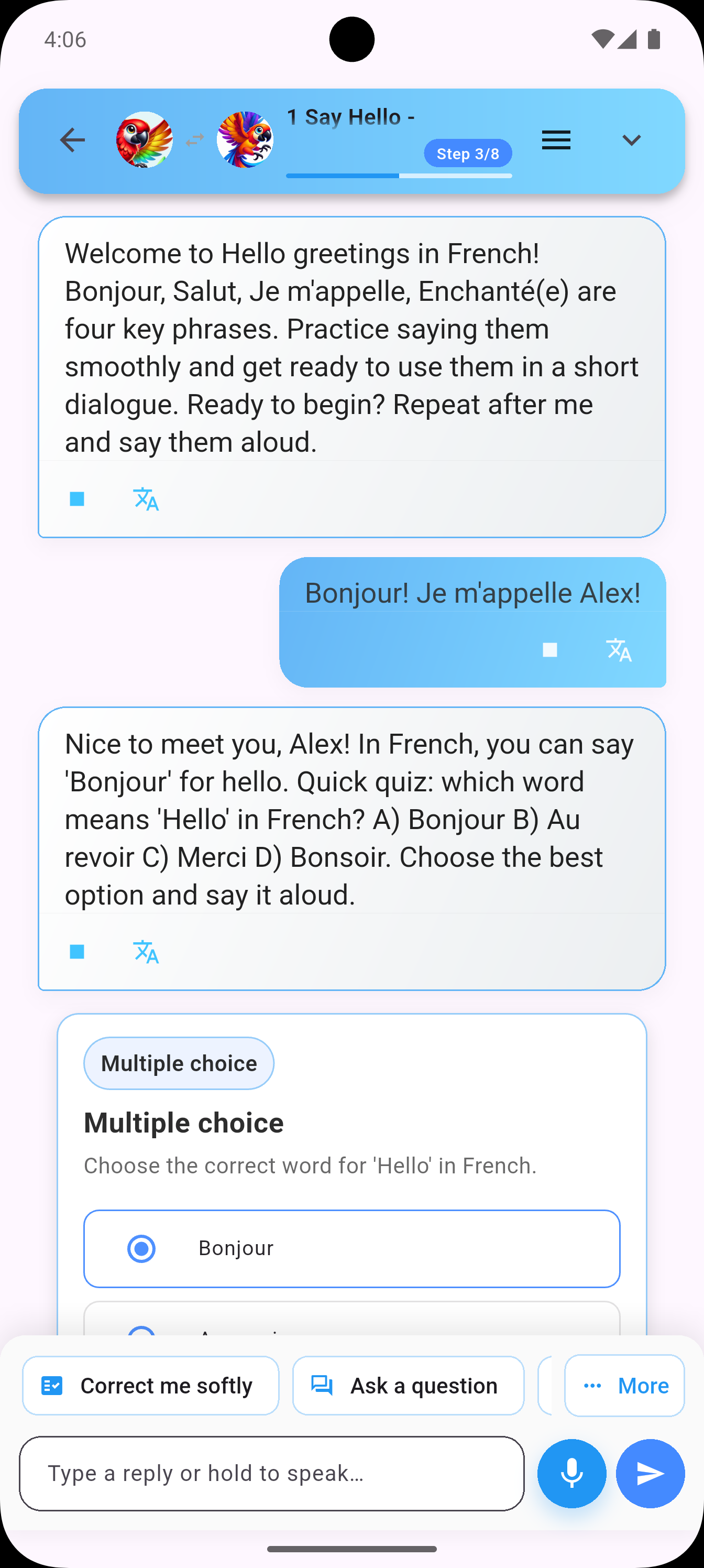
Practicing alone can absolutely work, but only if the session has enough shape and friction to resemble real speaking.
Replace random self-talk with one defined situation
Talking to yourself can help you become comfortable making sounds, but it becomes much more useful when the speech has a job. Choose a situation with a beginning, a likely sequence, and a result: return an item, make an appointment, explain your weekend, or ask for directions.
Write the situation at the top of a page and list the turns you expect. Do not script every sentence. Mark only the moments you must be able to handle. That gives you enough structure to practice without turning the exercise into memorized theater.
- Where are you and who are you speaking to?
- What do you need the other person to understand or do?
- Which follow-up question is most likely to disrupt you?
Use prompts that force a response instead of reciting a monologue
Conversation is reactive. A useful solo exercise needs an outside cue so you are not choosing the question and answer at the same time. Record the other person's lines, use prompt cards, pause an audio exchange before the response, or use roleplay that waits for your answer.
Keep the prompt short and answer aloud without writing first. If you need support, use a small phrase bank rather than a complete script. The goal is to preserve the moment of retrieval while lowering the difficulty enough that you can continue.
- Record three questions with five-second gaps.
- Shuffle prompt cards and answer the one you draw.
- Pause a dialogue and replace the next speaker.
- Use guided AI roleplay for unpredictable follow-ups.
Review for clarity first, then choose one improvement
Listening to a recording can become discouraging if you judge everything at once. Use a sequence. First ask whether the meaning is understandable. Then locate the longest pause or the moment you abandoned the message. Finally choose one phrase, sound, or structure to improve on the rerun.
A transcript can help reveal missing connectors and repeated filler. A model response can show a more natural option. Neither should replace your attempt. Feedback is most useful after you have produced something and immediately before you try it again.
- Meaning: did the response accomplish the job?
- Access: where did you pause, restart, or simplify too far?
- Upgrade: what single change will improve the next attempt most?
Make the same conversation harder one layer at a time
Repeating an identical script can become automatic without becoming flexible. Changing everything each day prevents fluency from building. A scenario ladder sits between those extremes: keep the setting and core language, then add one new demand after the base exchange feels manageable.
For a restaurant scenario, begin by ordering one item. Next ask a question about ingredients. Then respond when the item is unavailable. Finally repair a misunderstanding. Each step reuses the earlier language while expanding what you can handle.
- Complete the expected exchange.
- Add a follow-up question.
- Add a change or complication.
- Recover from a misunderstanding.
Create an outside prompt so the response is not fully preplanned
The weakness in casual self-talk is not solitude; it is control. You choose the topic, timing, vocabulary, and next turn, so nothing forces you to retrieve language you did not already have ready. Useful solo practice introduces an outside cue. A recorded question, shuffled prompt card, paused dialogue, or guided roleplay creates a moment you must answer rather than narrate around.
Keep the speaking job narrow. Record five questions a hotel receptionist might ask and leave a short gap after each. Answer without writing first. On the next run, shuffle the order or change one detail. The variation should be large enough to require attention and small enough that the core language remains reusable.
Output research gives a reason to attempt before reviewing. Producing language can reveal a form or phrase the learner did not notice was missing during comprehension. That gap makes later input more relevant. If the model answer always appears first, the learner loses some of that diagnostic value.
Support can remain available without becoming a script. Keep a phrase bank containing openings, connectors, and repair language. Use it only after an honest attempt. Over several runs, remove items that have become accessible and add the phrases that real failures reveal.
- Recorded questions, shuffled situation cards, pause-and-answer audio, or AI roleplay.
- Answer aloud before writing or viewing a model.
- Change one detail per run to preserve controlled variation.
Review a recording in passes instead of judging your entire voice
Recording is valuable because memory is a poor transcript of performance. Learners often remember only the worst pause or the general feeling of difficulty. Audio shows whether the message was complete, where time disappeared, and whether the same filler or restart pattern recurred. But listening without a method can turn into self-criticism rather than feedback.
Use three passes. On the first, listen only for meaning: would another person understand the intended result? On the second, mark access problems such as long pauses, abandoned sentences, or missing connectors. On the third, choose one upgrade in language or pronunciation. Do not transcribe and repair every sentence.
Then rerun the same prompt immediately. Corrective-feedback research is most useful here as a design principle: feedback must create an opportunity for uptake. The learner should do something different, not merely agree with the correction. A better second attempt is the unit of progress.
Save both recordings occasionally. Comparison over time can reveal faster starts and stronger range that daily emotion hides. Delete routine recordings if privacy matters; the learning value comes from review and retry, not from building a permanent archive of every mistake.
- Meaning first, retrieval second, one language upgrade third.
- Rerun while the feedback is still actionable.
- Compare selected baseline recordings rather than scoring every day.
Use a 20-minute loop with preparation, pressure, feedback, and return
A solo session needs a stopping rule and a progression rule. Without them, preparation expands until no speaking happens, or open practice wanders until the learner is tired. Divide the session by job. Use four minutes to understand the situation and refresh a few phrases. Use eight minutes for prompted responses and a full exchange. Use four minutes for review, then four for a corrected rerun.
The percentages can change, but speaking should occupy a meaningful share when speaking is the goal. Reading about a scenario for eighteen minutes and speaking for two may feel safe while preserving the passive-active gap. Conversely, twenty minutes of unsupported chat can repeat the same limited language without improvement.
End by saving no more than three items: one phrase you needed, one moment to vary, and one repair to practice. Those items choose tomorrow's opening retrieval. This continuity prevents each solo session from beginning with a blank decision.
Spacing research supports the return. Cepeda and colleagues synthesized 317 experiments and found that the timing of learning episodes interacts with desired retention. You do not need a perfect algorithm to use the insight. Retry now for correction, tomorrow for access, and later in a varied scenario for durability.
- 4 minutes prepare, 8 respond, 4 review, 4 rerun.
- Save only the highest-value gaps for tomorrow.
- Return later with variation rather than repeating one script forever.
Solo practice prepares interaction; it does not replace every human demand
Solo practice is unusually good for volume, privacy, and targeted repetition. It lets a learner retry an opening ten times without using another person's patience. It can prepare vocabulary and repair language before a higher-stakes moment. Those are major advantages, especially when access to tutors or partners is limited.
Human interaction still adds accent variation, social timing, emotional stakes, cultural expectations, and genuinely independent intentions. An AI or recording can simulate parts of that environment but cannot certify that every phrase is culturally appropriate or that speech recognition reflects every listener. Treat solo tools as rehearsal and feedback, not as an infallible judge.
Bridge gradually. Use the practiced exchange with a tutor, partner, community member, or predictable service interaction. Set a modest mission such as ask one follow-up rather than perform flawlessly. Afterward, capture what the solo practice predicted well and what surprised you.
Bring that evidence back into the next session. A human misunderstanding becomes a repair drill. An unfamiliar reply becomes a listening cue. A phrase that worked becomes part of the stable cluster. The strongest solo system remains connected to real communication even when most repetitions happen alone.
- Choose a narrow, low-risk human interaction.
- Set one observable mission and allow imperfect language.
- Turn surprises from the interaction into the next solo practice block.
Use shadowing as preparation, then remove the model
Shadowing—speaking with or immediately after audio—can focus attention on rhythm, linking, and intonation. Its limitation is that the model carries timing and language selection. Use it as a perception and coordination exercise, not as the final speaking test.
Choose a short exchange with a transcript. Listen for meaning, mark stress, and shadow a few times. Then hide the transcript, wait several seconds, and produce the same intention in your own words. Finally place the phrase into a prompted response.
Compare for intelligibility and rhythm before microscopic accent differences. Select one sound or timing feature that affects clarity. Retry inside the sentence; isolated sound work should return to communication quickly.
A short focused pronunciation block can improve confidence in a scenario, but avoid spending the entire speaking session imitating. The learner must eventually choose and retrieve language without the audio leading every millisecond.
- Listen for meaning before imitation.
- Remove audio and transcript after a few runs.
- Return one pronunciation target to a real response.
Expand scenarios by function instead of collecting topics
A month of solo practice should leave behind capabilities, not thirty unrelated recordings. Choose a functional theme each week: obtain information, describe and compare, narrate an event, or solve a problem. Apply the function to situations relevant to your life.
Within the week, use the same prepare–respond–review–rerun loop. Increase turn count and variation. At week's end, record one unscripted scenario and note the next boundary. The following week can reuse repair language while changing the main function.
Maintain a compact portfolio: baseline, final attempt, three recurring gaps, and situations now handled. This creates evidence without requiring a fake universal score. Review the portfolio monthly to choose whether range, speed, accuracy, or interaction needs priority.
Schedule human calibration when possible. A tutor or partner can sample the portfolio, flag unnatural patterns, and supply cultural or interactional feedback that solo systems may miss. One targeted human session can improve weeks of independent practice.
- Organize weeks by communicative function.
- Save compact baseline and final evidence.
- Use occasional human calibration strategically.
Fix the session when solo practice becomes repetitive or vague
If you repeat the same language, add a communicative constraint: explain, compare, persuade, or repair. If practice becomes random, restore one scenario and one outcome. If feedback is overwhelming, choose one meaning-blocking issue. If you avoid recording, use a live transcript or a brief post-session note instead.
When motivation drops, reduce setup. Keep prompts, model audio, and the next scenario ready. A session should begin with speaking within a few minutes. When difficulty spikes, restore one scaffold rather than abandoning the task or retreating into passive study for the entire session.
Plateaus often need better variation or external calibration. Change one cue, add a human sample, or ask a tutor to review a selected recording. More minutes are useful only after the session design still produces new information.
- Change the task before adding time.
- Restore one scaffold when performance collapses.
- Seek external calibration when patterns stop changing.
Sources and further reading
The research below informs the learning principles in this guide. Individual results depend on the learner, language, task, and practice conditions.
- Izumi et al. (1999), Testing the Output HypothesisA second-language study examining when producing language promotes noticing and later performance.
- Lyster & Saito (2010), Oral Feedback in Classroom SLA: A Meta-AnalysisA meta-analysis of oral corrective-feedback research in second-language instruction.
- ACTFL Proficiency Guidelines 2024 — SpeakingACTFL describes functional speaking through functions and tasks, accuracy, context and content, and text type (FACT).
- Cepeda et al. (2006), Distributed Practice in Verbal Recall TasksA quantitative synthesis covering 839 assessments from 317 experiments reported across 184 articles.