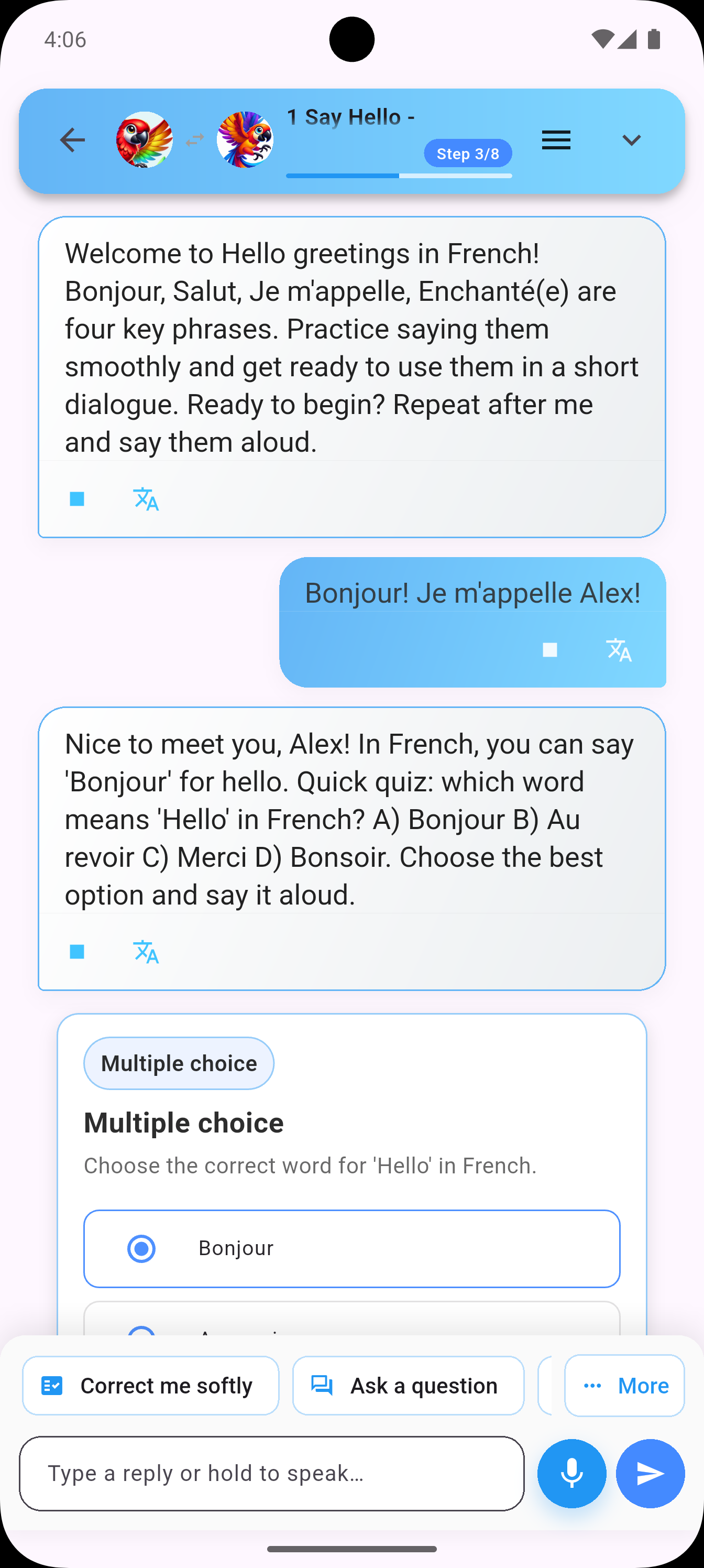
This comparison only helps if it stays focused on the job the learner is hiring the app to do.
These products can both be useful while solving different problems
A useful comparison begins with the result you are hiring the app to create. A habit-focused course can make daily exposure easy and repeatable. A speaking-first system can ask more of you through retrieval, roleplay, and scenario practice. Neither advantage matters equally at every stage.
If you are trying to establish a lightweight routine, friction matters. If you already show up but still cannot use what you know, the type of practice matters more. Comparing feature counts without naming the job produces a winner that may not fit your bottleneck.
- Build an easy daily language habit.
- Turn familiar language into usable responses.
- Prepare for a specific real-world conversation.
Recognition practice and speaking practice create different kinds of difficulty
Tapping an answer, matching a translation, and completing a course path can build exposure and familiarity. Creating a response, handling an unexpected follow-up, and repairing a mistake train access under pressure. Speaking-first practice often feels slower because fewer prompts protect you from retrieval.
Do not use ease as the only signal of quality. Ask whether the difficulty matches the ability you want. If real conversation is the goal, some productive struggle should appear where you must decide what to say and say it in time.
- How much time is spent recognizing versus producing?
- Does the practice continue after your first response?
- Do weak moments return in later review or roleplay?
The right answer can change as your bottleneck changes
A beginner may benefit from broad exposure and a predictable path. Later, that same learner may recognize hundreds of words while struggling to order a meal without rehearsing. The tool did not necessarily fail; the learner's limiting factor changed from exposure to active use.
Reassess when you notice a stable gap between what you understand and what you can say. You can keep light review while adding speaking-first work. The decision does not have to be exclusive if each tool has a clear role.
- Exercises feel easy but conversation still produces long pauses.
- You recognize the response as soon as someone else says it.
- Your study streak grows while your real-world range stays unchanged.
Compare both approaches against one off-screen scenario
Choose a conversation you care about and define what success looks like. Use each practice approach consistently, then run the same unscripted scenario. This keeps the comparison anchored to behavior rather than brand preference or the feeling of progress inside the app.
Notice how quickly you begin, how many turns you sustain, and whether you can recover when the script changes. If speaking is the decision criterion, those measures matter more than points, streak length, or lesson completion.
- Response: how quickly can you begin without notes?
- Range: how many turns can you sustain?
- Repair: can you keep going after a misunderstanding?
Compare the job each practice loop performs, not an abstract winner
A universal best-app ranking ignores learner stage. One person needs a frictionless reason to encounter the language daily. Another already studies consistently but cannot respond off-screen. A third needs preparation for a specific interview or trip. The same product can be useful for one job and insufficient for another.
Begin by writing the job in behavioral language. Build a daily habit is a job. Learn broad beginner material is a job. Handle a back-and-forth restaurant exchange is another. Then inspect how each product spends learner time: recognition, explanation, retrieval, speaking, feedback, or delayed review.
Feature sets change, so the comparison should not depend on a frozen checklist. Test the current product experience yourself before subscribing. The durable distinction is training design. Does the session mainly make study easy to continue, or does it deliberately require the kind of output your goal demands?
The answer may be both. A lightweight course can support exposure while a speaking-first tool handles targeted output. The arrangement works only if the easier activity does not quietly replace the practice attached to the stated goal.
- My current job is… My remaining bottleneck is… I will judge progress by…
- Verify current features and terms directly in each product.
- Allow a mixed routine only when every tool has a defined role.
Recognition, retrieval, interaction, and repair are not interchangeable
Recognition tasks can build familiarity and provide accessible early success. Retrieval tasks remove the answer and require reconstruction. Interaction adds a turn the learner does not fully control. Repair requires the learner to survive a gap or misunderstanding. Each layer includes demands the earlier one can avoid.
This explains the common experience of understanding an exercise and freezing in conversation without assuming the learner learned nothing. The recognition knowledge may be real. Transfer is limited because practice did not sufficiently require the later behaviors. More recognition can deepen one component while the bottleneck stays elsewhere.
Karpicke and Roediger's retrieval experiments are not language-app comparisons, but they establish a relevant general principle: repeated retrieval can produce stronger long-term learning than repeated study in their conditions. A speaking goal deserves practice where the answer is not continuously supplied.
Observe ten minutes in each app. Tally created responses, dependent follow-ups, opportunities to repair, and items that return after a delay. This behavioral audit is more informative than counting colorful feature labels.
- How often must you create meaning without visible answers?
- How often does your response change the next turn?
- What happens to weak language after the session ends?
Judge off-screen function without inventing level claims
Completion, points, and streaks can describe engagement. They do not by themselves establish speaking proficiency. ACTFL defines speaking with the FACT criteria and expects sustained performance across relevant situations. Official ratings require official tests and trained raters, not an informal app dashboard.
A product trial can still use functional outcomes. Define a situation, follow-up range, repair demand, and desired result. Record a baseline, practice for a fixed period, and rerun the situation with a controlled variation. Compare behavior rather than the number of units completed.
The relevant measures depend on the job. A habit goal can be measured by adherence without pretending adherence equals fluency. A speaking goal can track start latency, sustained turns, clarity, and repair. A vocabulary goal can track delayed retrieval and contextual use. Good decisions keep the product metric and learner outcome distinct.
This framing also makes claims fairer. Duolingo does not need to be dismissed for serving habit and broad study, and Kasa does not need to claim superiority at every job. The question here is narrower: which loop is better aligned when active speaking is the bottleneck?
- Engagement: did you return? Learning: what survived? Function: what can you accomplish?
- Match the metric to the stated goal.
- Do not translate in-app progress into an unsupported proficiency level.
Use the same two-week speaking experiment for both approaches
Select a real scenario and record a baseline with no complete script. Use approximately equal time for each approach or test them in separate periods. Keep the scenario stable enough to compare, but include one unseen follow-up so memorization cannot pass as flexibility.
During practice, track how much time reaches the bottleneck. If you spend twenty minutes but only one minute producing independent speech, record that honestly. Also note adherence and emotional friction. Effective practice must be demanding enough to train the skill and usable enough to continue.
At the end, compare the same behaviors: time to begin, number of turns sustained, amount of visible support required, and repair after a change. Do not expect two weeks to establish broad fluency. The experiment asks whether the training loop moves one defined capability in the right direction.
Then choose a role, not a winner. Keep the approach that improves the target. Retain the other only if it serves a separate job without crowding out speaking. Reassess when the bottleneck changes, because an honest language system should evolve with the learner.
- One scenario, comparable time, a baseline, and an unseen variation.
- Behavioral outcomes plus adherence—not a vibe alone.
- A decision about each tool's role after the experiment.
The important price is money plus the practice your time displaces
Subscription price matters, but so does opportunity cost. Twenty minutes of easy review may displace twenty minutes of the retrieval or roleplay your goal requires. A more demanding app can also waste time if setup, correction overload, or open-ended chat prevents focused repetition.
Compare a typical week, not a feature demo. Record total minutes, independent speaking minutes, delayed-review minutes, and planning overhead. Then connect those minutes to the scenario outcome. This reveals whether the product turns available time into the needed behavior.
Verify current prices, trials, renewals, and feature availability directly because product terms change. Do not build a long-lived comparison around a promotional price or beta feature. The article's durable job is to provide a method for rechecking.
Choose the smallest tool set that covers your jobs. Paying for overlapping novelty rarely improves the loop. A mixed approach is justified when one product reliably supports habit or input and another reliably trains output.
- Measure time by learning behavior.
- Verify current terms directly.
- Avoid paying twice for the same job.
Your best fit should change when your bottleneck changes
A beginner may prioritize comprehensible exposure and routine. An intermediate learner may prioritize retrieval and follow-up range. A traveler may temporarily narrow everything around urgent scenarios. Product fit is therefore a decision made for a stage, not an identity.
Set a reassessment trigger: every eight weeks, after a trip, or when off-screen performance stops changing. Rerun a baseline scenario and inspect where failure moved. The original tool may still work while another capability has become limiting.
Do not confuse familiarity with dependence. If an app feels indispensable, try the target behavior without it. A learning product should gradually reduce support in capabilities it has helped build, even while offering new challenges.
The honest conclusion remains conditional. Choose habit-oriented practice when adherence and broad exposure are the current job. Choose speaking-first practice when output, interaction, and repair are limiting. Combine them only with protected time and distinct purposes.
- Set a regular reassessment trigger.
- Test the capability without app support.
- Let the bottleneck—not loyalty—choose the next mix.
Make the comparison concrete enough to revisit later
Write your goal, bottleneck, weekly minutes, and target scenario. Assign each tool a job. Define the off-screen behavior that would justify keeping it. This takes the decision out of generic rankings and places it inside your actual routine.
After two weeks, inspect time allocation and transfer. Did the speaking-first time remain protected? Did the habit tool support exposure without replacing output? Did either product bring weak language back after a delay? Adjust roles from the evidence.
Revisit the template when the scenario becomes reliable or your circumstances change. The best comparison is not a permanent verdict. It is a repeatable method that keeps your tools aligned with the next communicative boundary.
- Assign every tool one explicit job.
- Define evidence required to keep it.
- Revisit when the bottleneck moves.
Sources and further reading
The research below informs the learning principles in this guide. Individual results depend on the learner, language, task, and practice conditions.
- ACTFL Proficiency Guidelines 2024 — SpeakingACTFL describes functional speaking through functions and tasks, accuracy, context and content, and text type (FACT).
- Karpicke & Roediger (2008), The Critical Importance of Retrieval for LearningExperimental evidence that repeated retrieval can strengthen long-term retention more than additional study alone.
- Cepeda et al. (2006), Distributed Practice in Verbal Recall TasksA quantitative synthesis covering 839 assessments from 317 experiments reported across 184 articles.
- Izumi et al. (1999), Testing the Output HypothesisA second-language study examining when producing language promotes noticing and later performance.